
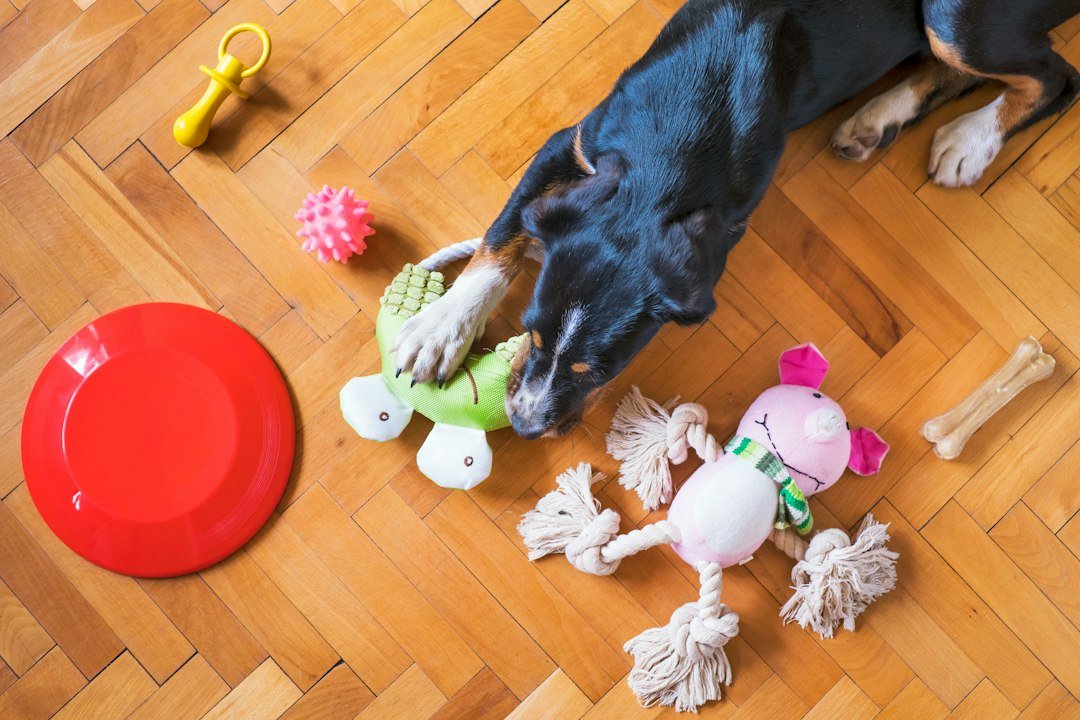
Walk down any pet aisle and you’ll see chew toys promising to be indestructible, dental, calming and long-lasting all at once. The truth is less exciting and more useful: the ‘best’ chew toy is the one that matches how hard your dog chews, and the most common mistake is buying something far too hard or far too soft. Below you’ll find three quick tests you can do in the shop, a simple matcher for chew strength, and the specific toys we’d buy first. Chewing also matters for barking — a dog with a good chew is a dog who is busy and settling — which is why this guide sits within our calming dog toys series.
Quick answer: Choose a chew toy by your dog’s chewing strength first, then size and material. It should be firm enough to last but give slightly when pressed, too big to swallow, and from a reputable maker. For most dogs our first pick is a stuffable rubber toy like the KONG Classic; power chewers need a tougher version, and teething puppies a softer one.
Why chew toys matter
Chewing does a lot for a dog: it satisfies a strong natural urge, helps keep teeth cleaner, burns off boredom and works as a genuine self-soothing behaviour. A dog with an appropriate chew is less likely to bark, whine or eat your skirting boards.
Three quick safety tests before you buy
Many chew-related tooth injuries come from toys that are simply too hard. These simple checks, widely recommended in veterinary dental advice, catch most problems:
- The fingernail test. Press your thumbnail firmly into the toy. If it leaves no mark at all, it may be hard enough to fracture a tooth. A little give is a good sign.
- The kneecap test. Tap the toy against your kneecap. If it would hurt to be hit with it, it’s probably too hard for your dog’s teeth.
- The swallow test. The toy should be too big to fit fully into your dog’s mouth or slip down the throat — and stay that way as it wears. Size up if in doubt.
Toys that fail the first two tests — very hard bones, antlers, hooves and some rock-hard nylon — are worth thinking twice about, especially for power chewers who bite down hardest.
Match the toy to the chewer
🐶
Gentle chewer
Mouths and nibbles; toys last months.
Try: softer rubber, plush with supervision, rope
🐕
Average chewer
Works at toys steadily; plush lasts days.
Try: standard stuffable rubber, flexible synthetic
🦶
Power chewer
Destroys most toys within hours.
Try: extra-tough rubber designed for power chewers
🍼
Teething puppy
Sore gums, baby teeth, chews everything.
Try: soft puppy rubber, freezable toys
Our picks
Best first chew toy for most dogs: KONG Classic. It’s the one we’d buy before anything else. The rubber has some give, it bounces unpredictably for play, and — most importantly for barking — it can be stuffed with food and frozen, turning a five-minute chew into a long, settling activity.
For power chewers: KONG Extreme. The black version of the same shape in a tougher rubber, designed for dogs who destroy the standard one. Still stuffable, still with a little give.
For teething puppies: Puppy KONG. A softer rubber made for baby teeth and sore gums — freeze it with a little wet food for extra relief. More options in our puppy chew toy guide.
Picks are based on design, materials and how well each toy supports calm settling — not on long-term testing with our own dogs. See our affiliate disclosure.
The main types of chew toy
- Rubber chew toys. The flexible all-rounder; stuffable designs can be filled and frozen.
- Hard nylon and synthetic chews. Built for heavy chewers — see our toughest chew toys for power chewers, and apply the fingernail test.
- Natural edible chews. Bully sticks and other long-lasting chews — covered with safety notes in natural long-lasting dog chews.
- Puppy and teething toys. Softer and often freezable — see the best puppy and teething chew toys.
- Rope and dental toys. A different texture that helps with teeth — supervise rope toys and throw them out once they fray.
Chew toy safety
Watch your dog with any new toy until you know how they treat it, and only leave genuinely chew-proof toys with an unsupervised dog. Check toys regularly and replace anything cracked, splintering or worn down to a swallowable size. Edible chews are best given when you’re around to supervise.
Pick by your dog
- Teething puppy → puppy & teething chew toys
- Strong or destructive chewer → toughest chew toys for power chewers
- Wants something natural and long-lasting → natural dog chews
- Anxious or bored dog → calming chew toys
Frequently asked questions
What are the best chew toys for dogs?
Ones that suit your dog’s chewing strength and size, are made from safe materials, and last. A stuffable rubber toy such as the KONG Classic suits most dogs; power chewers need a tougher rubber and puppies a softer one.
What is the safest dog chew toy?
One that’s the right size, made by a reputable company, firm but with a little give, and matched to how hard your dog chews — used with supervision at first. Avoid anything that splinters or breaks into pieces, and replace worn toys.
Are there any truly indestructible dog chew toys?
Not really — a determined power chewer can wear down almost anything. Tough rubber designed for heavy chewers comes closest. Inspect it regularly and replace it when it wears; our power-chewer guide has more options.
How many chew toys should a dog have?
A small rotation works best — two or three at a time, swapped every few days. Rotating keeps each toy interesting, which makes it more effective at settling your dog.
If you only do one thing, be honest about how hard your dog chews. It’s the biggest factor in choosing a toy that’s safe and actually lasts.