

One dog barks at the doorbell, and within a second the whole household joins in. If you live with more than one dog, you’ve probably seen how quickly barking spreads. Dogs pick up on each other’s excitement and alarm, so one barker can set off the rest, and a group can wind each other up far more than a single dog would. The answer is usually to work on the dogs one at a time, and to manage the moments when they set each other off. This guide is part of our complete humane guide to stopping dog barking.
Quick answer: Work out which dog usually starts the barking, and train each dog separately before practising together. Manage the triggers (block window views, soften the doorbell), give each dog their own space and resources, and teach every dog to go to their own mat for a reward when something sets them off. Never punish the group; it raises the tension that fuels the barking.
Get the free 3-Day Quiet-Down Checklist — a simple plan to start this week.
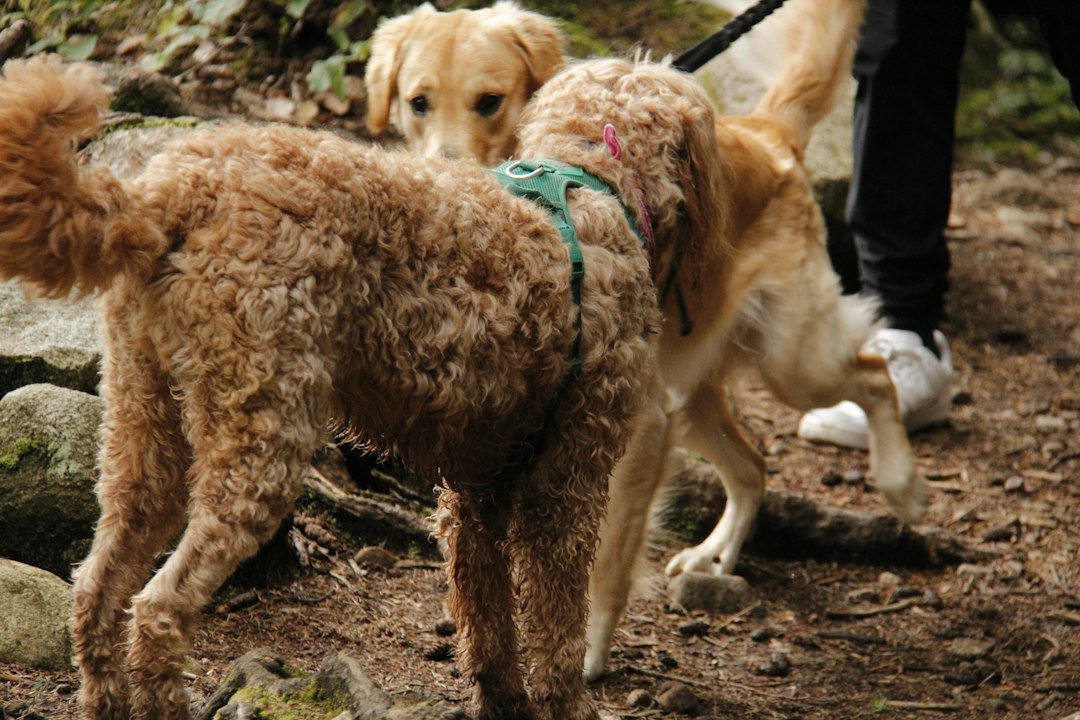
Why barking spreads between dogs
- Social facilitation. Dogs tend to join in with what other dogs are doing. If one dog alarm-barks, the others often assume there’s something to bark about.
- Rising excitement. Several dogs barking and running to the door together can whip each other into a frenzy.
- Competition. Tension over food, toys, resting spots or your attention can spill over into barking.
- Learning from each other. A new dog or puppy may pick up an older dog’s habit of barking at the window.
Step 1: find the starter
Watch, or film, a few barking episodes. Often one dog is the first to react and the others follow. Working with that dog first usually brings the biggest improvement. The printable Barking Log helps you spot who barks, when and at what.
Step 2: manage the triggers
- Block window views with film or blinds so the group can’t keep a lookout. See barrier frustration for more.
- Soften the doorbell or put up a ‘please knock’ sign while you train. Our doorbell guide covers this.
- Use baby gates to keep dogs apart at busy times, such as deliveries or visitors.
- Give each dog their own bed, water and space to rest, and feed them apart if there’s any tension over food.
Step 3: train one dog at a time
- Teach each dog a ‘go to your mat’ cue and a quiet cue on their own, in a calm room.
- Practise with a recorded doorbell or knock at a low volume, rewarding each dog for staying calm or going to their mat.
- Once each dog is reliable alone, practise with two dogs together, with a helper if you can, so each dog gets rewarded quickly.
- Build up slowly to the whole group and to real triggers.
When the group starts barking, don’t shout over them. Calmly call one dog at a time to you and reward each for coming. Shouting just adds to the noise and excitement.
Meet each dog’s needs
Each dog needs their own exercise, sniffing time and one-to-one attention. Dogs who are bored or under-exercised bark more, and a group of bored dogs can be very noisy. Our guide to boredom barking and enrichment has ideas you can use with each dog.
When to get help
If barking comes with growling, stiff standoffs or fights between your dogs, separate them safely and talk to your vet and a qualified, force-free behaviour professional. Tension between dogs in the same home needs proper help.
Frequently asked questions
Why do my dogs bark at the same time?
Dogs naturally join in when another dog barks, especially alarm barking. One dog often starts it and the others follow.
How do I stop my dogs setting each other off?
Manage the triggers, find which dog usually starts, and train each dog separately before practising together.
Will getting a second dog stop my dog barking?
Not usually. A second dog can pick up the first dog’s barking habits. It’s best to work on the barking first.
Should I separate my dogs to stop barking?
Separating them at trigger times, such as deliveries, can help a lot while you train. It isn’t a punishment, just good management.
Ready to start? Download the free 3-Day Quiet-Down Checklist.
For short daily practice sessions, the free Quiet Dog Toolkit has a training timer, and the printable Barking Log helps you track progress.