
When a dog barks and lunges at other dogs, the advice owners hear most is “they just need more socialising.” So they head to the dog park, or let every passing dog say hello — and things get worse. That’s because socialising an adult reactive dog means something quite different from socialising a puppy. The goal isn’t more encounters. It’s more calm encounters, at a pace your dog can handle, and plenty of them that involve no greeting at all. This guide explains how. It builds on our reactive dog training guide.
Quick answer: To socialize a reactive dog, focus on calm, neutral exposure rather than greetings. Start with observation at a comfortable distance, progress to parallel walks with a steady, calm dog, and only consider short, carefully chosen off-lead meetings much later. Skip dog parks and on-lead greetings, keep sessions short, and let your dog decide how close they want to get.
What socialisation really means for an adult reactive dog
For puppies, socialisation is about positive first experiences with the world during a sensitive early period. For an adult dog who is already worried or frustrated around other dogs, the job is different. You’re trying to teach your dog that other dogs can be around without anything bad happening — and that they don’t have to greet, play with or confront every dog they see.
That’s why the best ‘socialisation’ for many reactive dogs looks surprisingly dull: watching dogs go by from far away, walking alongside a calm dog without interacting, sniffing the same patch of grass a few minutes apart. Neutral is the goal. Many happy, well-adjusted adult dogs aren’t interested in meeting strangers at all, and that’s fine.
Step 1: calm observation from a distance
Before any walk together, your dog needs to be able to see other dogs without reacting. This is the foundation covered in our guide to desensitizing a reactive dog: work at a distance where your dog stays relaxed and eats, and make other dogs predict good things. Move on only when your dog can watch dogs at a moderate distance and then turn back to you.
Step 2: parallel walks
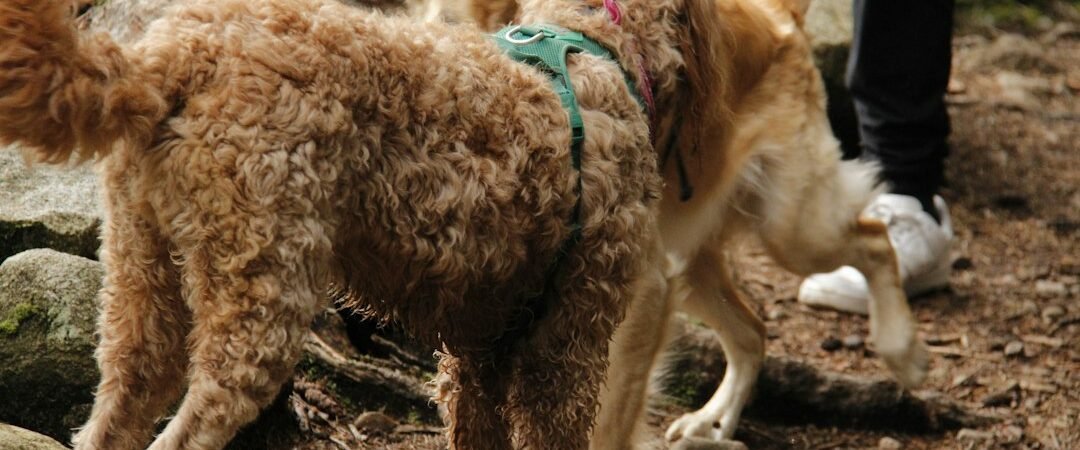
Parallel walking is the workhorse of reactive dog socialisation. Two dogs walk in the same direction, at a comfortable distance apart, without greeting. Walking side by side is far less confrontational than approaching head-on, and moving together gives both dogs something else to focus on.
You’ll need a helper with a calm, steady dog who won’t stare at or approach yours. Over a series of walks, the distance between the dogs shrinks:
Opposite sides of a field
Opposite pavements
Same path, a few metres apart
Walking with handlers between them
An illustration of the general progression; the pace depends entirely on your dog.
Tips that make parallel walks work:
- Start with the dogs walking the same direction, the helper dog slightly ahead so your dog can watch without being watched.
- Keep the handlers between the dogs as you get closer.
- Let them sniff where the other dog has been. Sniffing is information-gathering, and often relaxes dogs.
- Reward glances at the other dog and every check-in with you.
- Keep it short — ten or fifteen calm minutes is a success.
Step 3: carefully chosen dog friends
Some reactive dogs, after plenty of calm parallel walks, enjoy having one or two dog friends. If you get there:
- Choose the dog carefully. Calm, socially fluent adult dogs who don’t push or stare are ideal; boisterous adolescents usually aren’t.
- Meet on neutral ground after a parallel walk, when both dogs are relaxed.
- Keep leads loose or, in a secure space, dropped — tight leads cause tension.
- Keep the first meeting very short — a few seconds of sniffing, then call your dog away and walk on.
Signs a meeting is going well: loose, wiggly bodies; curved approaches; sniffing then moving away; play bows; dogs taking turns and pausing. Signs to calmly end it: stiffening, freezing, hard stares, raised hackles, one dog repeatedly trying to leave, or play that only goes one way. Our guide to the signs of a reactive dog covers the body language in more detail.
What to avoid
- Dog parks. Unpredictable, crowded and often full of pushy greeters — the opposite of the controlled exposure a reactive dog needs.
- On-lead greetings. Tight leads and head-on approaches are where many reactions start; see our leash reactive dog guide.
- ‘Letting them sort it out.’ Throwing a reactive dog in with others to ‘learn’ can cause fights and deepen fear.
- Day care as a fix. For some reactive dogs, a full day surrounded by dogs is overwhelming. Talk honestly with any day care about your dog’s needs.
Socialising beyond dogs
If your dog is reactive to people, the same principles apply: observation at a distance, then parallel walks with a calm friend, then very brief, low-pressure meetings where the person ignores your dog and simply tosses a treat. Our guide to why dogs bark at people has more on this. And on difficult days, a quiet ‘decompression’ walk — a long line in an empty field, lots of sniffing, no triggers — is valuable socialisation in its own way: it gives your dog the chance to explore the world while feeling safe.
Frequently asked questions
Is it too late to socialize a reactive dog?
It’s never too late to help a reactive dog feel more comfortable around other dogs and people. The window for puppy-style socialisation has passed, but adult dogs can still learn through calm, gradual exposure and positive associations.
Should I take my reactive dog to a dog park?
Generally not. Dog parks are unpredictable and crowded, and greetings there tend to be rushed and intense. Planned parallel walks with a calm dog are far more effective and much safer.
How do I introduce my reactive dog to another dog?
Start with a parallel walk at a comfortable distance and gradually close the gap over one or more sessions. When both dogs are relaxed, allow a very brief sniff on loose leads or in a secure area, then move them apart and walk on.
Does my reactive dog need dog friends?
Not necessarily. Many dogs live happy lives with no dog friends at all, as long as they can be around other dogs calmly. Being comfortable and neutral matters more than being sociable.
For a reactive dog, socialisation isn’t about meeting more dogs — it’s about feeling safe around them. Quiet, calm, boring encounters are exactly what progress looks like.